


Label Gap Sensor and Fork Sensor: Working, Uses & Key Differences
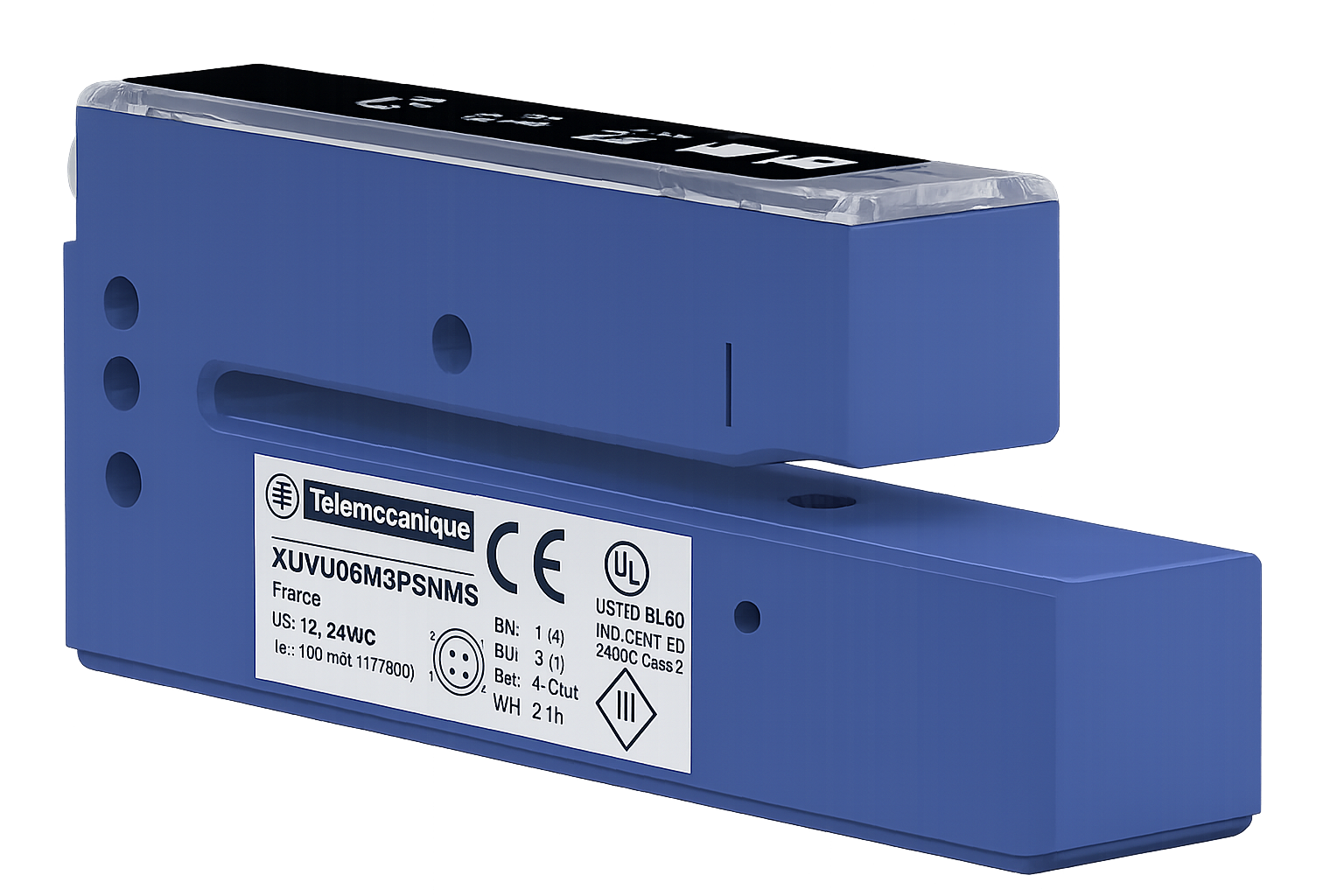
A Label Gap Sensor is a specialized industrial sensor designed to detect labels, gaps, and transitions between labels as they move on a backing liner. It plays an important role in automatic labeling, packaging, printing, and converting machines where precise label positioning is essential. By detecting each label or the gap between consecutive labels, the sensor provides a reliable switching signal to the machine controller, helping control dispensing, counting, printing, cutting, and registration operations.
In modern automated production lines, even a small error in label detection can result in incorrect positioning, material waste, product rejection, or machine downtime. This is why dedicated label detection technology is preferred over general-purpose object sensors for applications requiring repeatable label positioning.
What Is a Label Gap Sensor?
A Label Gap Sensor is an industrial sensing device specifically designed to identify the difference between a label and its carrier or backing material. In a typical roll-fed labeling application, labels are arranged continuously on a liner:
Label → Gap → Label → Gap → Label
As the label web passes through the sensing area, the sensor identifies the change between the label and the gap or liner. It then generates an electrical output that can be connected to a PLC, labeling controller, printer, dispenser, or other automation equipment.
Unlike a conventional photoelectric sensor that is primarily designed to detect the presence or absence of an object, a label gap sensor is optimized for detecting subtle transitions within a continuously moving web.
Main Functions
A Label Gap Sensor can be used for:
- Label positioning
- Label counting
- Label dispensing
- Print registration
- Cutting synchronization
- Material indexing
- Applicator control
- Machine cycle synchronization
The appropriate sensor technology depends on the label material, liner, transparency, thickness, gap size, machine speed, and environmental conditions.
How Does a Label Gap Sensor Work?
The exact working principle depends on the sensing technology used. Optical fork-style sensors are widely used, while ultrasonic technology may be selected for certain transparent or difficult-to-detect materials.
A typical optical label gap sensor works through the following process:
1. Label Web Enters the Sensor
The continuous label material passes through the sensing area of the sensor. In a fork-style design, the material passes through a narrow slot between the transmitter and receiver.
2. Sensor Emits a Detection Signal
An optical sensor uses a light source to monitor the material. Depending on the design, infrared or another suitable light source may be used.
3. Label and Liner Produce Different Conditions
The label and backing liner affect the transmitted light differently. The electronics monitor this difference as the label moves through the sensing slot.
4. Transition Is Identified
When the sensor detects a change corresponding to the label-to-gap or label-to-liner transition, its internal electronics process the signal.
5. Output Signal Is Generated
Once the detection threshold is reached, the sensor switches its output. Depending on the model, NPN or PNP outputs may be available.
6. Machine Controller Responds
The PLC or dedicated controller uses the signal to perform the required operation, such as positioning the next label, triggering a printer, stopping the dispenser, or synchronizing an applicator.
Some dedicated models also provide teach-in or dynamic learning functions to simplify setup for different label materials. Genesis Technomation's product information, for example, describes dynamic teaching, light/dark switching, and NPN/PNP output on its GX GAP-VE04B04M8 model.
What Is a Fork Sensor?
A Fork Sensor is a sensor in which the transmitter and receiver are integrated into a single U-shaped or slot-style housing. The material being detected passes through the opening of the fork.
This construction provides a significant advantage: the transmitter and receiver are permanently aligned. Unlike separate through-beam sensors, there is generally no need to independently position and align two sensor units.
Fork sensors are particularly useful when a machine requires precise detection in a limited installation space.
How Fork Sensors Work
The operating process is relatively simple:
- The emitter generates the sensing signal.
- The receiver monitors the signal.
- The target material passes through the fork.
- The material changes the received signal.
- Internal electronics evaluate this change.
- The sensor switches its output.
- The PLC or machine controller receives the signal.
Depending on the sensor type, the sensing technology can be optical or ultrasonic.
Fork Sensors in Labeling and Packaging
Fork sensors are widely useful in labeling and packaging automation because the material can pass directly through the sensor's slot while the sensing components remain fixed in alignment. They can be used for label detection, tag detection, web detection, counting, positioning, and other repetitive material-handling tasks.
For example, a label applicator can use a fork-style sensor to detect the transition between successive labels. When the sensor detects the required transition, its output can tell the controller when to stop, advance, or trigger the next machine operation.
Fork-style construction is also useful when space around the label web is limited and repeatable installation is important.
Label Gap Sensor vs Fork Sensor: Key Differences
The terms Label Gap Sensor and Fork Sensor are sometimes used interchangeably, but they describe different aspects of a sensing solution.
A Label Gap Sensor primarily describes the application or detection task, whereas a Fork Sensor describes the physical construction of the sensor.
| Feature | Label Gap Sensor | Fork Sensor |
|---|---|---|
| Primary definition | Sensor designed to detect labels and gaps | Sensor with integrated emitter and receiver in a fork housing |
| Main application | Label detection and positioning | Material, label, tag, gap, and edge detection |
| Construction | May use different configurations | Fixed U-shaped/slot construction |
| Alignment | Depends on sensor design | Emitter and receiver are factory-aligned |
| Typical use | Labeling, printing, packaging | Labeling, counting, positioning, packaging |
| Installation | Depends on model | Material passes through the fork |
| Sensing technology | Optical, ultrasonic, or other technologies | Optical or ultrasonic depending on model |
| Best advantage | Accurate label-gap detection | Simple alignment and compact installation |
Therefore, a fork sensor can function as a label gap sensor when it is specifically designed and configured for label detection.
Optical vs Ultrasonic Label Gap Detection
Choosing the correct sensing principle is important when dealing with different label materials.
Optical Label Gap Sensors
Optical sensors use changes in light transmission or attenuation to identify the difference between labels and their carrier.
They are often suitable for conventional opaque labels where there is sufficient difference between the label and liner.
Ultrasonic Label Sensors
Ultrasonic sensors use high-frequency sound rather than relying on visible or infrared light. In dedicated ultrasonic label sensors, differences in ultrasonic attenuation between the label/carrier combination and the carrier alone can be used to distinguish labels.
This technology can be useful when transparent, semi-transparent, glossy, or optically challenging labels make conventional optical detection more difficult.
However, the correct choice should always be based on testing the actual label and liner combination.
Applications of Label Gap and Fork Sensors
Label Gap and Fork Sensors are used across numerous industrial automation applications.
1. Automatic Labeling Machines
They detect the position of individual labels so the applicator can dispense labels accurately.
2. Packaging Machines
Sensors can detect packaging material movement and provide indexing or positioning signals.
3. Printing Machines
They can provide a reference signal for print registration and synchronization.
4. Pharmaceutical Packaging
Precise label detection is important for bottles, cartons, containers, and other pharmaceutical packaging.
5. Food and Beverage Packaging
Label sensors help maintain consistent label positioning on bottles, containers, and packaged products.
6. FMCG Production
High-speed consumer goods lines require reliable label detection to minimize errors and material waste.
7. Logistics and Barcode Labeling
Fork and label sensors can help detect labels, tags, and material transitions during automated processing.
8. Counting and Positioning
Fork sensors can also be used to count tags, sheets, products, or other materials passing through their sensing area.
Key Benefits
Using a dedicated label or fork sensor can provide several advantages.
High Detection Accuracy
The sensor is designed to recognize small transitions between labels and their carrier material.
Fast Machine Operation
High-speed sensing is important for automated labeling and packaging equipment where material moves continuously.
Easy Installation
Fork construction integrates the sensing elements into one housing, reducing alignment requirements.
Consistent Label Positioning
Reliable detection helps the machine maintain repeatable label placement.
Reduced Material Waste
Accurate detection reduces incorrect dispensing, misplaced labels, and unnecessary material consumption.
Easy Machine Integration
Depending on the model, sensors can provide outputs suitable for PLCs and automation controllers. Some models offer NPN and PNP outputs for flexible integration.
Compact Design
Fork-style sensors are particularly useful where machine builders have limited mounting space.
Factors to Consider Before Buying a Label Gap Sensor
Selecting a sensor only by its name is not sufficient. Consider the actual application conditions.
Label Material
Determine whether the label is paper, plastic, transparent, metallic, glossy, or another material.
Liner Material
The difference between the label and liner is critical for reliable detection.
Label Thickness
Very thin labels may require a more sensitive sensing technology.
Gap Size
Check the minimum gap that needs to be detected.
Machine Speed
The sensor's response time and switching frequency should be appropriate for the production speed.
Sensor Output
Check whether the machine requires PNP, NPN, relay, analog, or another output configuration.
Fork Width and Depth
For fork sensors, ensure the label web can pass comfortably through the sensing slot.
Environmental Conditions
Consider dust, vibration, temperature, moisture, and other environmental factors.
Mounting Space
A compact fork design can be advantageous where space is limited.
Best Place to Buy Label Gap Sensors
For industries looking for reliable label detection solutions in India, Genesis Technomation India Pvt Ltd is a strong option for sourcing Label Gap Sensors and Fork Sensors. The company offers label/fork sensor solutions for labeling, packaging, printing, and automation applications and lists products from brands including SICK, Banner, and Telemecanique.
Genesis Technomation India Pvt Ltd – Label Gap Sensor & Fork Sensor Products
Its listed range includes models such as GAP-VE04B04M8, XUVE04M3KSNM8, XUVU06M3KSNM8, WFS3-40P415, GS 61/6, GS 61/6-S8, GSU12/6GX.3-M12, and GS63B/6D-S8.
For the best selection, buyers should provide details such as label material, liner type, label thickness, gap size, machine speed, available mounting space, and PLC input requirements. This allows the appropriate sensor technology and model to be selected rather than relying only on general specifications.
Conclusion
Label Gap Sensors and Fork Sensors are important components in modern labeling, packaging, printing, and material-handling automation. A Label Gap Sensor focuses on detecting labels and the gaps or transitions between them, while a Fork Sensor refers primarily to the compact U-shaped construction in which the emitter and receiver are permanently aligned.
Their combination of precise detection, compact installation, reliable switching, and automation compatibility makes them valuable for high-speed production systems. Optical technology is often suitable for conventional opaque labels, while dedicated ultrasonic sensing can be considered for transparent or optically challenging materials.
The right sensor should always be selected according to the label material, liner, thickness, gap, machine speed, sensing technology, output type, mounting dimensions, and operating environment. For Indian industries seeking dependable label detection solutions, Genesis Technomation India Pvt Ltd can be considered as a supplier for Label Gap Sensors and Fork Sensors, with technical selection based on the actual machine application.

