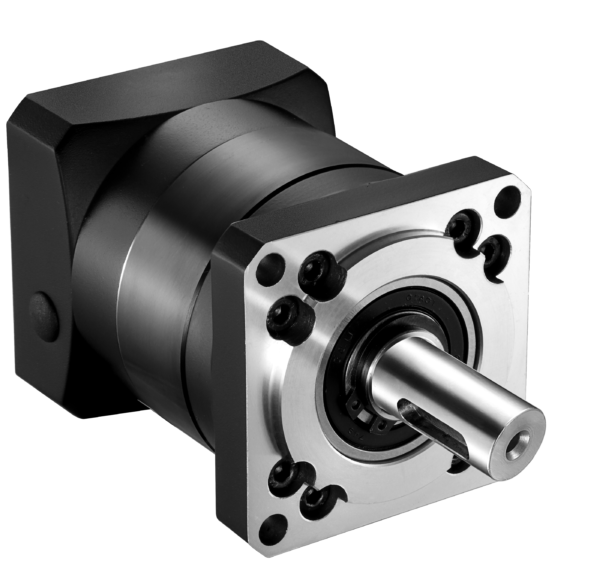
A Stepper Motor Planetary Reducer is a precision gear reduction system designed to work with a stepper motor to reduce output speed while increasing available torque. It combines the controlled, incremental movement of a stepper motor with the compact and high-torque transmission characteristics of a planetary gearbox. This combination is widely used in industrial automation, CNC machines, robotics, packaging equipment, labeling machines, printing systems, conveyors, and precision positioning applications where controlled motion, torque multiplication, and reliable mechanical transmission are required.
A stepper motor is capable of precise incremental rotation, but direct-drive operation is not suitable for every machine. Some applications require lower output speed and significantly higher torque. A planetary reducer provides the required mechanical advantage while maintaining a compact design. Selecting the correct gear ratio, torque rating, backlash, motor compatibility, and operating conditions is essential for achieving reliable performance.
What Is a Stepper Motor Planetary Reducer?
A Stepper Motor Planetary Reducer is a planetary gearbox specifically designed to be coupled with a stepper motor.
A planetary gear system generally consists of:
- Sun gear
- Planet gears
- Ring gear
- Planet carrier
- Input shaft
- Output shaft
- Bearings
- Housing
The stepper motor provides the rotational input, while the planetary gearbox modifies the speed and torque characteristics.
The basic arrangement is:
Stepper Motor → Planetary Reducer → Reduced-Speed Output → Machine Load
The reducer converts the relatively high-speed rotation of the motor into slower rotation with increased output torque. The actual torque increase depends on the gear ratio, gearbox efficiency, motor torque, and operating conditions.
Why Use a Planetary Reducer With a Stepper Motor?
Stepper motors are commonly used where controlled positioning and incremental movement are required. However, a machine may require more torque or lower speed than the motor can provide directly.
A planetary reducer can help address these requirements.
It can provide:
- Higher output torque
- Lower output speed
- Better load matching
- Compact mechanical transmission
- Improved mechanical advantage
- Low-backlash options
- High torque density
For example, a stepper motor operating at a relatively high speed can be connected to a reducer with an appropriate gear ratio. The reducer lowers the output speed and increases the available torque at the output shaft.
This can make the motor more suitable for driving mechanisms with higher mechanical resistance or specific positioning requirements.
Working Principle of a Stepper Motor Planetary Reducer
The working principle is based on planetary gear transmission.
1. Stepper Motor Produces Rotation
The stepper motor receives electrical pulses from its driver. Each pulse causes the motor shaft to move through a defined angular increment according to the motor's step configuration.
The motor therefore provides controlled rotational movement.
2. Motor Drives the Sun Gear
The motor shaft is connected to the reducer input.
In a common planetary arrangement, the input drives the central sun gear.
3. Sun Gear Drives Planet Gears
The sun gear engages with several planet gears positioned around it.
As the sun gear rotates, the planet gears rotate around their own axes while also moving around the central axis.
4. Planet Gears Engage With the Ring Gear
The planet gears mesh with the internal teeth of the ring gear.
The interaction between the sun gear, planet gears, and ring gear produces the required reduction.
5. Planet Carrier Produces Output
The planet gears are supported by the planet carrier.
In a typical reduction arrangement, the carrier becomes the output member and rotates at a lower speed than the motor input.
6. Output Speed and Torque
The reducer produces a lower-speed output with increased torque.
A simplified relationship is:
Output Speed ≈ Input Speed ÷ Gear Ratio
And:
Output Torque ≈ Input Torque × Gear Ratio × Efficiency
These relationships are simplified. Actual performance depends on gearbox construction, efficiency, load, speed, lubrication, and other factors.
Main Components of a Planetary Reducer
Sun Gear
The sun gear is located at the center of the planetary arrangement and generally receives the input from the stepper motor.
Planet Gears
Several planet gears surround the sun gear. Multiple gears share the transmitted load, contributing to the gearbox's torque capacity.
Ring Gear
The ring gear surrounds the planet gears and contains internal teeth that mesh with them.
Planet Carrier
The carrier holds the planet gears and can serve as the output member in a reduction configuration.
Bearings
Bearings support rotating components and maintain the required mechanical alignment.
Housing
The housing protects the internal gear mechanism and provides the mounting interface for installation.
Types of Stepper Motor Planetary Reducers
Single-Stage Planetary Reducer
A single-stage planetary gearbox provides a moderate reduction ratio using one planetary gear stage.
It is suitable where the machine requires a relatively modest reduction and torque increase.
Benefits
- Compact design
- Lower mechanical complexity
- Good efficiency potential
- Suitable for moderate reduction requirements
Multi-Stage Planetary Reducer
Multiple planetary stages can be combined to provide higher reduction ratios.
They are suitable when greater speed reduction and higher output torque are required.
However, additional stages can increase gearbox length, weight, mechanical complexity, and losses.
Inline Planetary Reducer
In an inline configuration, the motor input and gearbox output share the same central axis.
This arrangement is common in automation equipment because it provides a straightforward and compact transmission layout.
Right-Angle Gear Arrangement
Some applications require the output direction to change relative to the motor.
A right-angle configuration can be used where machine layout does not permit an inline arrangement.
Key Features of Stepper Motor Planetary Reducers
High Torque Density
Planetary gearboxes distribute the transmitted load across multiple planet gears. This enables high torque transmission within a relatively compact package.
Compact Construction
The planetary gear arrangement allows several gears to work around a common center, reducing the space required for a given transmission capability.
Low Backlash Options
Precision planetary reducers can be manufactured with low backlash.
Backlash is the small amount of lost motion caused by clearance between mating gear teeth. Low backlash is important in applications involving accurate positioning and frequent direction changes.
High Efficiency
A well-designed planetary gearbox can achieve high transmission efficiency. Actual efficiency varies according to the number of stages, load, speed, lubrication, and gearbox design.
High Rigidity
Mechanical rigidity helps minimize unwanted movement when the load changes direction.
This is particularly important for precision automation and positioning applications.
Applications of Stepper Motor Planetary Reducers
Stepper Motor Planetary Reducers are used in numerous industrial automation and motion-control applications.
CNC Machines
CNC equipment requires controlled movement of machine axes. A geared stepper motor can provide the required combination of controlled movement, output torque, and speed reduction.
Applications include:
- Axis movement
- Rotary positioning
- Indexing
- Tool positioning
Robotics
Robotic systems require controlled and repeatable movement.
Planetary reducers can be used with stepper motors for:
- Rotary mechanisms
- Positioning systems
- Grippers
- Small robotic joints
- Automated handling systems
Packaging Machines
Packaging machinery contains multiple controlled movements that must operate in synchronization.
Stepper Motor Planetary Reducers can be used for:
- Feeding mechanisms
- Indexing systems
- Cutting mechanisms
- Product positioning
- Dispensing systems
Labeling Machines
Labeling equipment requires accurate feeding and positioning of labels.
A geared stepper motor can provide controlled movement for label feeding and indexing mechanisms.
Printing Machines
Printing equipment requires precise movement of rollers and material webs.
Planetary reducers can help provide controlled output speed and torque for specific motion-control functions.
Conveyor Systems
Small conveyors and indexing conveyors can use geared stepper motors where precise movement and increased output torque are required.
Automated Assembly Equipment
Assembly machines often need accurate positioning of components.
A stepper motor combined with a planetary reducer can provide controlled movement while increasing the mechanical torque available at the output.
Benefits of Stepper Motor Planetary Reducers
1. Higher Output Torque
The main advantage of a planetary reducer is torque multiplication. The gear ratio provides mechanical advantage, allowing the output shaft to deliver greater torque than the motor shaft alone.
2. Lower Output Speed
Many automation mechanisms require slow, controlled movement. The reducer lowers the output speed according to the selected gear ratio.
3. Better Load Matching
A gearbox allows the motor to be matched more effectively with the mechanical load.
4. Compact Design
Planetary gearboxes provide high torque density, making them suitable for machines where installation space is limited.
5. Improved Positioning Characteristics
When appropriately selected, a low-backlash planetary reducer can support precise positioning and repeatable movement.
6. Better Mechanical Advantage
The reduction ratio provides mechanical advantage, helping the stepper motor drive loads that require greater output torque.
7. Load Sharing
Multiple planet gears share the transmitted load, allowing the gearbox to handle substantial torque within a compact design.
How to Select a Stepper Motor Planetary Reducer
Selecting the correct reducer requires evaluation of both motor and machine requirements.
1. Output Torque
Determine the torque required by the driven mechanism.
Consider:
- Static load
- Dynamic load
- Acceleration
- Friction
- Mechanical losses
- Safety factor
2. Output Speed
Determine the required output RPM and select a suitable gear ratio.
A basic calculation is:
Gear Ratio = Motor Speed ÷ Required Output Speed
3. Backlash
Precision applications should be evaluated according to the reducer's backlash specification.
Low backlash is especially important for CNC, robotics, indexing, and positioning applications.
4. Motor Compatibility
Check:
- Motor frame size
- Shaft diameter
- Shaft length
- Mounting pattern
- Pilot diameter
- Motor torque
The reducer must be mechanically compatible with the stepper motor.
5. Radial and Axial Load
Check the maximum radial and axial loads that the gearbox can safely handle.
This is especially important when pulleys, sprockets, gears, or belts are attached to the output shaft.
6. Duty Cycle
Consider whether the application operates continuously or intermittently and whether it involves frequent acceleration, deceleration, and reversing.
7. Operating Environment
Consider temperature, dust, moisture, vibration, and other environmental factors.
Stepper Motor Planetary Reducer vs Standard Gearbox
| Feature |
Planetary Reducer |
Standard Gearbox |
| Torque density |
Generally high |
Depends on design |
| Compactness |
High |
Varies |
| Load distribution |
Multiple planet gears |
Depends on gear arrangement |
| Backlash |
Low-backlash options available |
Depends on design |
| Precision applications |
Well suited |
Application dependent |
| Efficiency |
Generally high |
Depends on gearbox type |
| Typical applications |
Automation and motion control |
General industrial drives |
Planetary reducers are particularly attractive where compact dimensions, torque density, and precision motion are important.
Maintenance of a Planetary Reducer
Correct installation and maintenance help maximize gearbox life.
Check Mounting
Ensure the motor and reducer are securely mounted.
Check Alignment
Improper shaft alignment can increase bearing and coupling loads.
Monitor Temperature
Unexpected temperature increases may indicate overload, lubrication problems, or mechanical issues.
Monitor Noise and Vibration
Unusual noise or vibration can indicate gear, bearing, coupling, or alignment problems.
Follow Lubrication Requirements
Use the lubrication specified by the gearbox manufacturer and follow the recommended maintenance procedure.
Avoid Overloading
Operating above the rated torque can cause premature gear and bearing wear.
Where to Buy Stepper Motor Planetary Reducer in India?
For manufacturers, machine builders, automation integrators, and industrial users looking to buy a Stepper Motor Planetary Reducer, Genesis Technomation India Pvt Ltd is a suitable supplier to consider.
Genesis provides industrial automation and motion-control products, including a dedicated Stepper Motor Planetary Reducer product range.
Before purchasing, customers should provide important application details such as:
- Stepper motor model
- Motor frame size
- Motor torque
- Required output torque
- Required output speed
- Gear ratio
- Backlash requirement
- Duty cycle
- Radial load
- Axial load
- Mounting arrangement
- Operating environment
Providing these specifications helps in identifying a planetary reducer that is appropriate for the actual application.
For businesses seeking a Stepper Motor Planetary Reducer supplier in India, Genesis Technomation India Pvt Ltd can be considered for industrial automation and motion-control requirements.
Frequently Asked Questions
What is a Stepper Motor Planetary Reducer?
It is a planetary gearbox designed to work with a stepper motor. It reduces output speed and increases available output torque while retaining the controlled motion characteristics of the stepper motor.
What is the main benefit of a planetary reducer?
The main benefits include torque multiplication, speed reduction, compact construction, high torque density, and the availability of low-backlash designs.
Does a planetary reducer increase stepper motor torque?
It increases the available output torque through mechanical advantage. Actual output torque depends on the motor, gear ratio, gearbox efficiency, and operating conditions.
What applications use planetary reducers with stepper motors?
They are used in CNC machines, robotics, packaging equipment, labeling machines, printing systems, conveyors, automated assembly machinery, and other motion-control applications.
Why is backlash important?
Backlash represents lost mechanical movement between mating gears. Low backlash can improve positioning accuracy, particularly in precision and reversing applications.
How do I select the correct planetary reducer?
Consider the required output torque, output speed, gear ratio, backlash, motor compatibility, radial and axial loads, duty cycle, and operating environment.
Conclusion
A Stepper Motor Planetary Reducer provides an effective way to combine controlled stepper-motor movement with mechanical speed reduction and torque multiplication. Its planetary gear arrangement uses a sun gear, multiple planet gears, a ring gear, and a planet carrier to transmit motion within a compact package.
These reducers are suitable for applications where direct-drive stepper motors cannot provide the required combination of output speed, torque, and mechanical load handling. They are commonly used in CNC machines, robotics, packaging equipment, labeling systems, printing machinery, conveyors, and automated assembly systems.
The correct reducer should be selected based on actual machine requirements rather than only the motor size. Output torque, gear ratio, speed, backlash, motor compatibility, radial and axial loads, duty cycle, and environmental conditions should all be evaluated.
For businesses looking for a Stepper Motor Planetary Reducer in India, Genesis Technomation India Pvt Ltd offers a dedicated product range for industrial automation and motion-control applications. You can explore the Genesis Technomation Stepper Motor Planetary Reducer range and provide your motor and application specifications to identify a suitable solution.