


Business Leads: Strategies, Sources, Benefits, and Best Practices
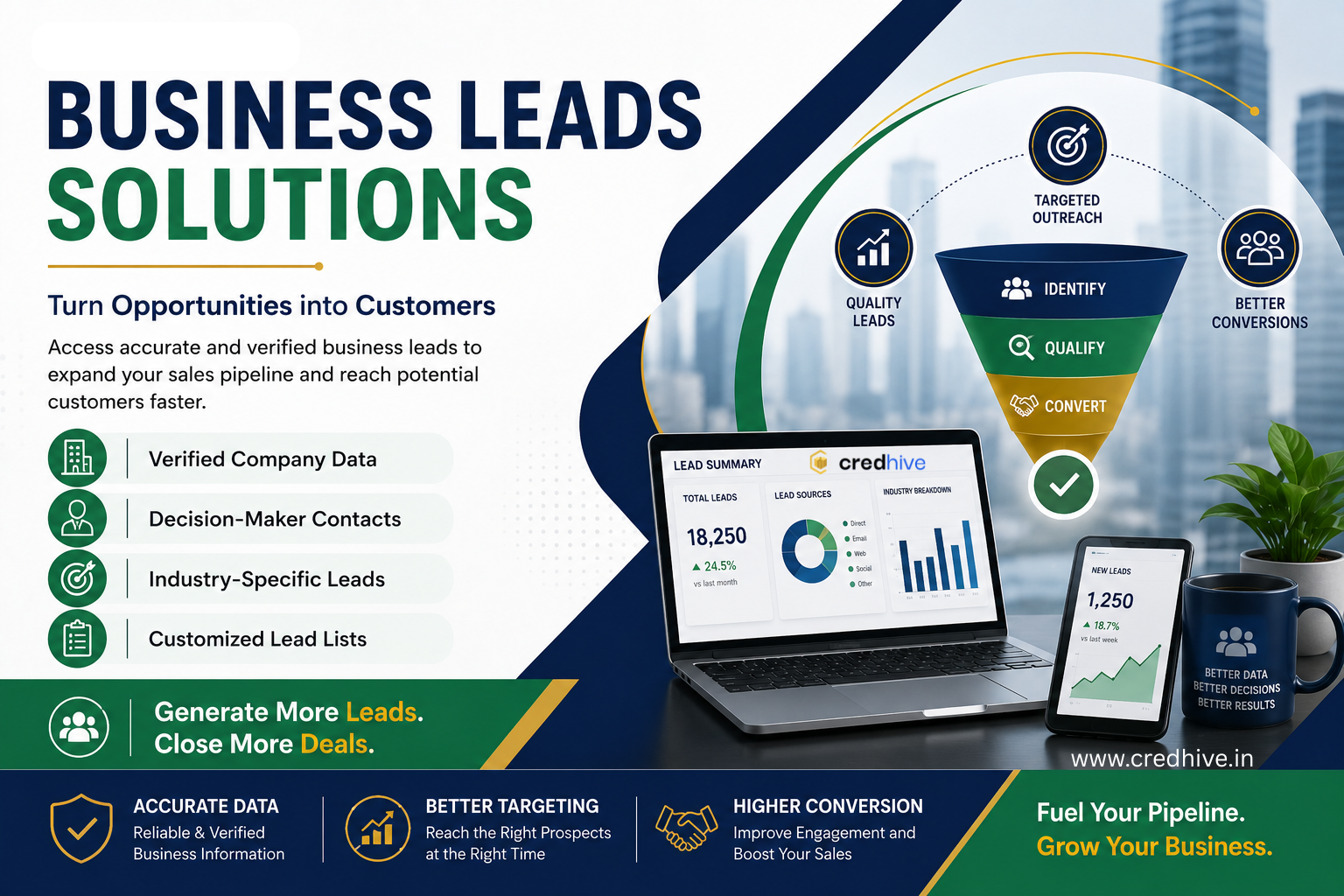
Business leads are individuals, companies, or decision-makers who have the potential to become customers of a business. A lead may be identified through a website enquiry, referral, business database, industry event, digital campaign, outbound sales activity, or other source.
For B2B organizations, generating leads is only the starting point. The real value comes from identifying prospects that fit the company's target market and have a genuine business requirement.
For banks, NBFCs, fintech companies, insurers, SaaS providers, and other B2B organizations, high-quality business leads can support sales growth while helping teams focus their time on relevant prospects.
Why Are Business Leads Important?
A consistent lead pipeline helps businesses reduce dependence on a small number of customers or irregular sales opportunities. However, lead volume alone does not indicate the strength of a pipeline.
A database containing thousands of unverified contacts may generate less business value than a smaller group of companies with accurate information and a clear need for the product.
Effective business lead generation can help organizations:
- Identify potential customers within specific industries
- Reach decision-makers more efficiently
- Expand into new markets
- Build a predictable sales pipeline
- Improve sales-team productivity
- Support account-based marketing
- Identify cross-selling and upselling opportunities
The quality of lead data is therefore just as important as the number of leads generated.
Major Sources of Business Leads
1. Business Databases
Business databases can provide information about companies, industries, locations, business activities, and key decision-makers.
For B2B sales teams, structured company information can make it easier to create targeted prospect lists rather than approaching businesses without a defined profile.
2. Digital Marketing
Search engines, social media, email campaigns, webinars, landing pages, and content marketing can generate inbound leads.
For example, an NBFC offering working-capital finance to SMEs could publish useful content around cash-flow management and use enquiry forms to identify businesses interested in financing solutions.
3. Referrals and Existing Customers
Existing customers can be an important source of new business opportunities. Referral programs, partner networks, and customer relationships can introduce prospects who already have some understanding of the organization's offering.
4. Industry Events and Networking
Trade exhibitions, conferences, business associations, and professional events can help sales teams connect with companies operating within specific sectors.
The advantage is that conversations can provide context that a basic contact record cannot capture.
5. Outbound Sales
Sales teams may identify target companies and approach them through email, phone, professional networks, or other channels.
Outbound campaigns tend to perform better when they are based on a clearly defined customer profile rather than sending the same message to a large, unrelated audience.
How to Qualify Business Leads
Not every prospect should receive the same level of sales attention. Business lead qualification helps organizations determine which opportunities deserve immediate follow-up.
Common qualification factors include:
- Industry and business segment
- Company size
- Geographic location
- Product or service requirement
- Decision-maker availability
- Estimated purchase potential
- Existing relationship
- Budget or financing requirement
- Timing of the business need
A fintech company selling an automated underwriting solution, for instance, may prioritize lenders that already process substantial SME applications rather than businesses that do not have a relevant lending operation.
Importance of Accurate Business Data
Lead generation becomes less effective when contact information is incomplete or outdated.
A useful B2B lead record may include company name, business activity, location, website, relevant decision-makers, contact information, and other information that helps the sales team understand the prospect.
Data validation can reduce issues such as duplicate records, incorrect contact details, inactive businesses, and irrelevant prospects.
For financial services organizations, additional business information may also support preliminary segmentation and relationship assessment. However, sales lead information should not automatically be treated as sufficient evidence for credit or risk decisions.
Role of Technology in Business Lead Generation
A business lead generation platform can help organizations collect, organize, enrich, segment, and manage prospect information.
CRM systems can then track activities such as:
- Lead source
- Contact history
- Sales stage
- Follow-up dates
- Qualification status
- Conversion outcome
- Assigned salesperson
Analytics can help management understand which sources generate qualified opportunities rather than simply measuring the total number of leads.
Automation can also support lead routing. For example, leads from manufacturing companies in North India could be automatically assigned to a sales team responsible for that segment.
Practical Example
Consider an NBFC that provides financing to small and medium-sized manufacturers.
Instead of purchasing a broad database of businesses, its sales team could define a target profile based on industry, location, company size, operating history, and financing requirements.
The organization can then identify relevant businesses, validate available information, segment the prospects, and prioritize those showing characteristics aligned with its product.
The sales team can approach these prospects with more relevant communication. If a company expresses interest, the lead can move into a formal application and underwriting process.
This distinction is important: lead generation identifies potential business; underwriting determines credit suitability.
Best Practices for Managing Business Leads
Define an Ideal Customer Profile
Before generating leads, identify the type of organization most likely to benefit from the product or service.
Prioritize Lead Quality
Measure qualified opportunities and conversions, not just the number of contacts collected.
Keep Data Updated
Regularly validate contact and company information to reduce wasted sales effort.
Segment Prospects
Group leads by industry, location, company size, product interest, or other meaningful characteristics.
Track the Complete Lead Lifecycle
Organizations should understand where leads come from, how they progress, and why opportunities are won or lost.
Connect Marketing and Sales
Marketing and sales teams should use consistent definitions for leads, qualified prospects, opportunities, and conversions.
Conclusion
Business leads provide the foundation for B2B sales development, but generating a large contact list is not enough. Businesses need accurate information, clear qualification criteria, effective segmentation, and structured follow-up to turn prospects into meaningful opportunities.
For banks, NBFCs, fintech companies, insurers, and enterprises, combining business data with CRM and lead-management technology can improve sales visibility and help teams concentrate on relevant prospects. The strongest lead-generation strategy is ultimately one that connects the right business with the right offering at an appropriate time.
FAQs
What are business leads?
Business leads are potential customers or organizations that may have an interest in a company's products or services and could eventually become customers.
How can businesses generate quality leads?
Businesses can generate quality leads through targeted databases, digital marketing, referrals, industry events, partnerships, outbound sales, and content-driven campaigns.
What is B2B lead qualification?
B2B lead qualification is the process of evaluating prospects based on factors such as business profile, requirement, company size, decision-making authority, and potential purchase or financing need.
Why is lead data quality important?
Accurate data helps sales teams reach relevant prospects, reduce duplicate or outdated records, and spend more time on opportunities with genuine business potential.
Can business leads be used for credit decisions?
Business leads can support prospect identification and initial segmentation, but they should not by themselves determine creditworthiness. Formal credit decisions require appropriate underwriting, verification, and risk assessment.

