


NBFC Underwriting Platform: A Practical Guide to Smarter Digital Lending
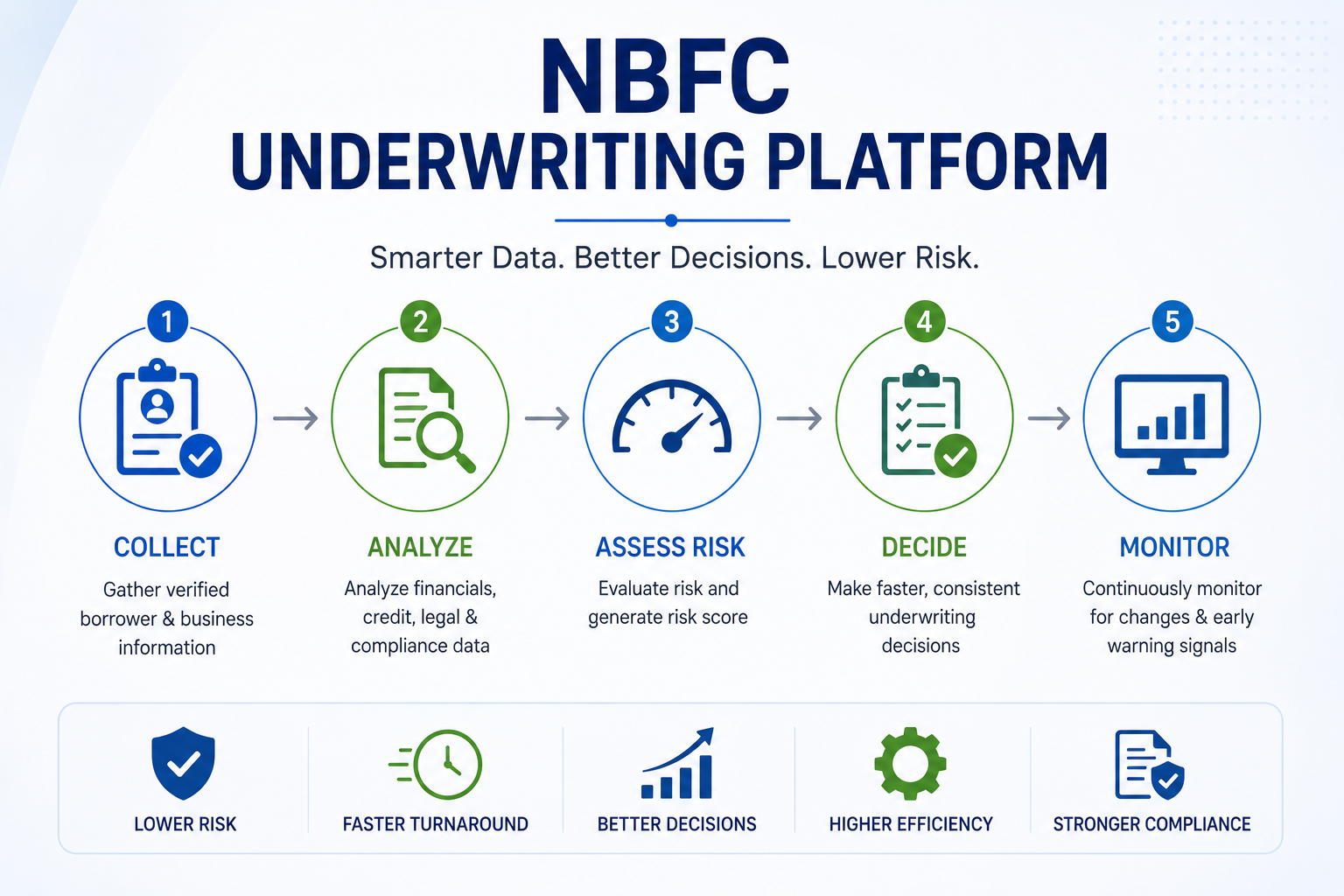
NBFCs play an important role in providing credit to individuals, MSMEs, and businesses that may not always be adequately served by traditional banking channels. As lending volumes grow, underwriting teams need to evaluate borrowers quickly without compromising on risk assessment.
An NBFC underwriting platform helps streamline this process by bringing borrower, business, financial, credit, legal, and compliance information into a structured digital workflow. Instead of relying on manual document reviews and disconnected data sources, lenders can use technology to assess risk more efficiently and make more consistent lending decisions.
For NBFCs, the objective is not simply to approve applications faster. A strong underwriting process should also improve portfolio quality, reduce operational effort, identify potential fraud, and provide better visibility into borrower risk.
What Is an NBFC Underwriting Platform?
An NBFC underwriting platform is a technology-enabled system designed to help non-banking financial companies evaluate loan applications and make credit decisions.
The platform can collect and analyze information such as:
- Borrower and business details
- Financial statements
- Credit history
- Banking and cash-flow information
- GST and tax-related information
- Corporate and ownership records
- Director and promoter details
- Existing liabilities
- Litigation and legal records
- Compliance indicators
- Business and industry risk signals
By combining these inputs, an underwriting platform can provide credit teams with a more complete view of an applicant.
For example, an NBFC assessing an MSME loan application may find that the applicant has healthy revenue but increasing debt, declining cash flow, and unresolved legal proceedings. Looking at these indicators together can help the underwriter determine whether additional verification or risk mitigation is required.
Why Do NBFCs Need an Underwriting Platform?
Faster Loan Processing
Manual underwriting can involve collecting documents, checking multiple databases, verifying information, and coordinating between different teams. A digital platform can automate many repetitive activities and reduce processing time.
Faster decisions can also improve customer experience, particularly for borrowers who expect digital lending processes.
Better Risk Assessment
Traditional underwriting may focus heavily on historical financial information. An underwriting platform can combine financial data with corporate, legal, ownership, and compliance intelligence to provide broader risk visibility.
Consistent Credit Decisions
Standardized workflows help different underwriters follow the same assessment methodology. This can reduce variations caused by manual processes and individual interpretation.
Reduced Operational Work
Automation can minimize repetitive data entry, document collection, and verification tasks, allowing credit teams to focus on complex applications and exceptions.
Key Features of an NBFC Underwriting Platform
1. Digital Borrower Assessment
The platform can create a centralized borrower profile containing relevant financial and business information.
This allows underwriters to review key details without moving between multiple systems.
2. Financial Analysis
Financial ratios and trends can help assess profitability, liquidity, leverage, working capital, and repayment capacity.
Rather than evaluating a single financial year, lenders can analyze trends to identify improvement or deterioration.
3. Business and Corporate Verification
For business borrowers, verifying the legal entity and its ownership structure is important.
An underwriting platform may help review company registration, directors, promoters, ownership, business status, and related entities.
4. Credit Risk Assessment
Credit history, repayment behavior, existing obligations, and other relevant credit indicators can contribute to the overall risk assessment.
5. Legal and Compliance Checks
Litigation, regulatory developments, and compliance indicators can provide additional context when evaluating a borrower.
A borrower facing significant legal or regulatory concerns may require enhanced due diligence before approval.
6. Risk Scoring and Decision Rules
Platforms can apply predefined credit policies and risk rules to classify applications and identify cases requiring further review.
Automated rules can help route straightforward applications through faster workflows while directing higher-risk cases to experienced underwriters.
7. Early Warning Signals
An effective underwriting platform should not stop at loan approval. Monitoring changes in financial performance, ownership, litigation, compliance, and business activity can help identify emerging risks.
How Does an NBFC Underwriting Platform Work?
Step 1: Application and Data Collection
Borrower information and supporting documents are captured digitally.
Step 2: Data Verification
Information is checked and standardized to identify inconsistencies or missing details.
Step 3: Risk Analysis
Financial, credit, business, legal, ownership, and compliance indicators are analyzed.
Step 4: Risk Classification
The borrower is assessed according to the NBFC's credit policy and risk parameters.
Step 5: Credit Decision
The underwriter can approve, reject, or request additional information based on the assessment.
Step 6: Ongoing Monitoring
After disbursement, the borrower can continue to be monitored for material changes that may affect credit risk.
Role of AI and Automation in NBFC Underwriting
Artificial intelligence and automation can significantly improve the scalability of digital underwriting.
AI-assisted systems can help identify unusual patterns, extract information from documents, match business entities, analyze large datasets, and prioritize applications for human review.
For example, if an application contains inconsistencies between declared business activity, financial information, and corporate records, automated checks can flag the case before final approval.
However, AI should support—not completely replace—human credit judgment. NBFCs should maintain appropriate controls for explainability, data quality, model validation, privacy, and regulatory compliance.
Benefits of Using an NBFC Underwriting Platform
A well-designed NBFC underwriting platform can help lenders achieve:
- Faster credit decisions
- Improved borrower risk assessment
- Reduced manual underwriting
- More consistent credit policies
- Better fraud detection
- Stronger compliance controls
- Improved customer turnaround time
- Better portfolio visibility
- Earlier identification of emerging risks
- Greater underwriting scalability
For instance, an NBFC handling thousands of MSME applications can use automated risk rules to process lower-risk cases efficiently while assigning complex applications to senior credit professionals.
Best Practices for NBFC Digital Underwriting
Combine Multiple Data Points
Credit scores alone may not provide enough information. Combining financial, corporate, legal, compliance, and business intelligence can provide a broader risk view.
Use Risk-Based Workflows
High-risk applications should receive deeper verification, while lower-risk applications can follow streamlined processes.
Keep Data Updated
Outdated information can lead to inaccurate credit decisions. Relevant borrower and business data should be refreshed regularly.
Connect Underwriting With Portfolio Monitoring
Risk does not end when a loan is approved. Linking underwriting with ongoing monitoring can help NBFCs identify deterioration earlier.
Maintain Human Oversight
Automated decisions should operate within clearly defined credit policies, with human intervention available for complex or high-value cases.
Frequently Asked Questions
What is an NBFC underwriting platform?
An NBFC underwriting platform is a digital system that helps non-banking financial companies collect, verify, analyze, and assess borrower information to support credit decisions.
How does an underwriting platform help NBFCs?
It can reduce manual work, accelerate loan processing, improve risk assessment, standardize credit workflows, and provide better visibility into borrower and business risk.
What data is used by an NBFC underwriting platform?
Depending on the lender and product, information may include financial statements, credit history, banking data, GST information, corporate records, ownership details, litigation, compliance data, and business information.
Can an NBFC underwriting platform help detect fraud?
Yes. Automated verification, entity matching, document analysis, relationship mapping, and anomaly detection can help identify inconsistencies and potential fraud indicators.
Can underwriting platforms monitor borrowers after loan approval?
Yes. Advanced platforms can connect underwriting with portfolio monitoring and early warning signals to identify significant changes in a borrower's financial, legal, corporate, or compliance profile.
Conclusion
An NBFC underwriting platform can help lenders build a faster, more structured, and data-driven credit decision process. By bringing together financial, credit, corporate, legal, ownership, and compliance information, it gives underwriters greater visibility into borrower risk.
For NBFCs, the greatest value comes from combining automation with sound credit judgment. Automated data collection and risk rules can improve efficiency, while experienced underwriters can focus on complex decisions and exceptions.
As digital lending continues to expand, technology-enabled underwriting can help NBFCs balance three important objectives: faster customer service, stronger risk management, and sustainable portfolio growth.