


Servo Motor Planetary Reducer: Precision, Torque & Speed Applications!
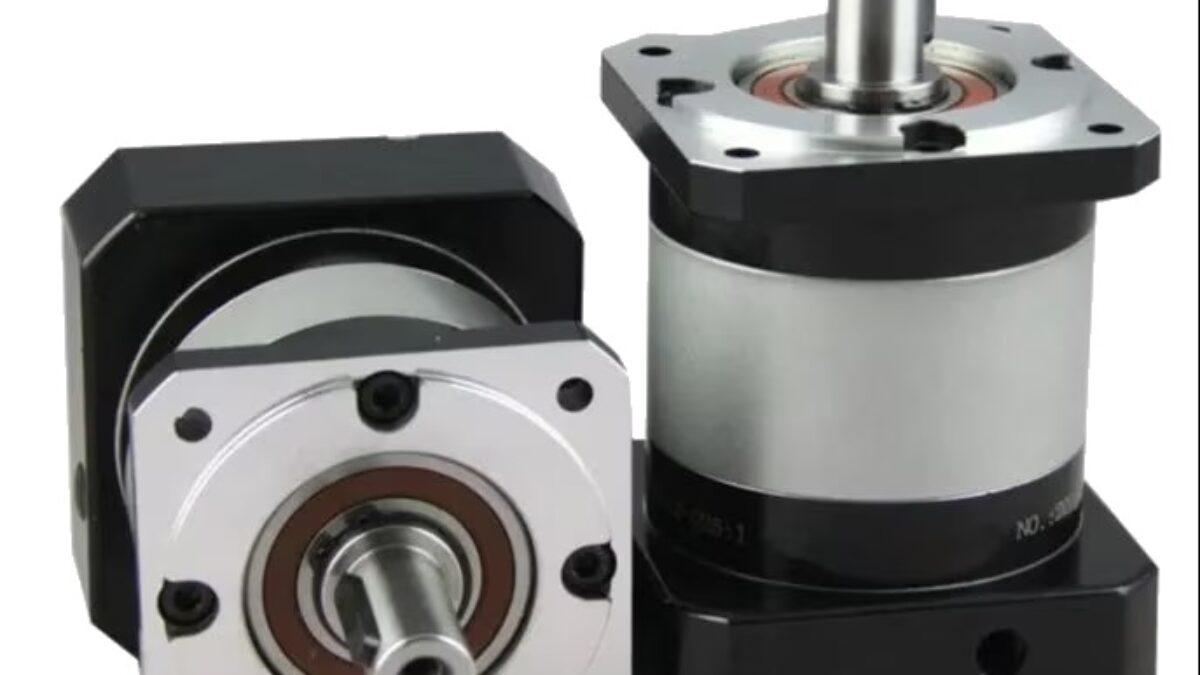
A Servo Motor Planetary Reducer is a critical motion-control component used when a servo motor needs higher output torque, controlled speed, improved mechanical resolution, and reliable load transmission. Servo motors already provide excellent speed and positioning control, but many industrial machines require mechanical characteristics that cannot be achieved efficiently with the motor alone. A planetary reducer bridges this gap by reducing output speed while multiplying torque and providing a compact, rigid transmission system. This makes servo planetary reducers valuable in CNC machines, robotics, packaging machinery, printing equipment, automated assembly systems, and other precision automation applications.
What Is a Servo Motor Planetary Reducer?
A Servo Motor Planetary Reducer is a precision gearbox designed to work with servo motors. It uses a planetary gear mechanism consisting primarily of a sun gear, multiple planet gears, a planet carrier, and a ring gear.
Unlike a conventional gearbox where power may be transmitted through fewer gear contacts, a planetary arrangement allows multiple planet gears to share the transmitted load. This provides high torque density, compact construction, and efficient power transmission.
The primary functions of a planetary reducer are to:
- Reduce output speed
- Increase output torque
- Improve mechanical resolution
- Support higher loads
- Provide controlled motion transmission
- Maintain compact machine dimensions
- Reduce the mechanical effect of motor speed on the driven mechanism
Genesis Technomation's Servo Motor Planetary Reducer range includes PRF-series configurations such as PRF40, PRF60, PRF80, PRF90, PRF120, and PRF160, with different reduction ratios and torque capacities.
Why Use a Planetary Reducer With a Servo Motor?
Servo motors are designed for precise speed, torque, and position control. However, the motor's native output characteristics may not match the requirements of the machine.
For example, a servo motor may rotate at a relatively high speed while the application requires slower movement with substantially higher torque.
Installing a planetary reducer changes the mechanical relationship between the motor and load.
A reducer can provide:
Higher Output Torque
Reduction increases the mechanical advantage available at the output shaft. This allows the servo system to drive heavier loads without necessarily requiring a physically larger motor.
Lower Output Speed
A high-speed servo motor can be connected to a gearbox with an appropriate ratio to obtain the lower output speed required by the machine.
Better Mechanical Resolution
Because the gearbox reduces output rotation relative to motor rotation, small motor movements are translated into smaller output movements.
Higher Load Capacity
Planetary gearboxes distribute transmitted forces across multiple gear contacts, making the configuration suitable for applications requiring high torque density and load transmission.
Genesis states that its servo planetary reducers are intended to increase torque, improve motion-control precision, reduce output speed, and match servo motor characteristics to mechanical system requirements.
How Does a Servo Motor Planetary Reducer Improve Precision?
Precision is one of the most important reasons for using a planetary gearbox with a servo motor.
A servo system uses feedback to control position, speed, and torque. However, the mechanical transmission between the motor and the machine also influences the final positioning result.
A high-quality planetary reducer can help by providing:
- Low backlash
- High torsional rigidity
- Controlled transmission
- Stable torque transfer
- Consistent mechanical positioning
Genesis identifies low backlash and high torsional rigidity among the characteristics of its PRF planetary gearbox series. The published torsional rigidity values vary by gearbox size, from 0.7 Nm/arcmin for PRF40 to 35 Nm/arcmin for PRF160.
Understanding Backlash
Backlash refers to the small amount of mechanical clearance between mating gear teeth.
In precision applications, excessive backlash can cause unwanted movement when the direction of rotation changes.
For example, imagine a CNC axis moving forward and then reversing. If the gearbox has significant backlash, the motor can rotate through a small amount of movement before the mechanical output fully responds.
This can affect:
- Positioning accuracy
- Repeatability
- Surface finish
- Registration accuracy
- Robotic positioning
- Indexing performance
For this reason, low-backlash planetary reducers are frequently considered for servo-driven precision applications.
However, gearbox backlash is only one part of total system accuracy. Encoder resolution, coupling compliance, mechanical rigidity, bearing condition, load variation, and machine structure must also be considered.
Torque Multiplication and Servo Applications
Torque is the rotational force available to drive a mechanical load.
A servo motor may provide excellent speed and positioning performance, but an application can require significantly greater torque at the machine output.
A planetary reducer allows engineers to trade output speed for mechanical torque.
For example, a reduction ratio of 5:1 means the output rotates at approximately one-fifth of the input speed under the corresponding gearbox arrangement, while output torque is increased according to the gearbox's mechanical characteristics and efficiency.
Actual output torque should always be based on the gearbox's rated specifications rather than simply multiplying motor torque by the ratio.
Genesis publishes rated torque values for its PRF range across multiple ratios. Depending on gearbox size and configuration, the listed rated torque extends from lower-torque PRF40 configurations to substantially higher capacities for PRF160.
Choosing the Correct Reduction Ratio
Selecting the correct ratio is one of the most important parts of servo gearbox selection.
The ratio should be based on the machine's:
- Required output speed
- Required output torque
- Motor rated speed
- Peak speed
- Load inertia
- Acceleration requirements
- Duty cycle
- Positioning requirements
A low reduction ratio may be suitable when high output speed is important.
A higher ratio may be useful when the application requires greater output torque and lower speed.
Genesis's PRF range includes multiple ratios, including 3:1, 4:1, 5:1, 7:1, 10:1 and other configurations depending on the gearbox size and stage.
The correct ratio should therefore be selected based on actual machine requirements rather than simply choosing the highest available reduction.
Servo Motor Planetary Reducer and Speed Control
Servo motors are widely used in high-speed automation because they can accelerate, decelerate, and change speed rapidly.
However, many mechanical loads operate more effectively at lower speeds.
A planetary reducer provides a mechanical method of matching the servo motor's speed range with the required output speed.
For example, a high-speed servo motor can drive a gearbox while the gearbox provides a slower output suitable for:
- Ball screws
- Belt drives
- Rotary tables
- Indexing mechanisms
- Rollers
- Conveyors
- Robotic joints
Genesis specifies maximum input speeds up to 8,000 rpm for some PRF models, while the permissible speed varies according to gearbox size.
This makes it important to check both rated and maximum input speeds when selecting a reducer.
Load Capacity and Mechanical Performance
A servo planetary reducer must be capable of handling the mechanical forces generated by the application.
There are three important load categories.
Radial Load
Radial load acts perpendicular to the output shaft.
Belts, pulleys, sprockets, and gears can generate radial forces.
Axial Load
Axial load acts along the shaft axis.
Certain screw mechanisms and vertical applications can create significant axial forces.
Torque Load
Torque is the rotational force transmitted through the gearbox.
The gearbox must be selected according to continuous torque, peak torque, acceleration requirements, and application duty cycle.
Genesis's published PRF specifications provide maximum allowable radial and axial loads for different gearbox sizes. For example, PRF40 is listed with maximum allowable radial and axial loads of 185 N and 150 N respectively, while the PRF160 is listed at 2,250 N radial and 1,500 N axial.
These specifications demonstrate why gearbox size must be matched to the actual mechanical load.
High Torsional Rigidity
Torsional rigidity describes how resistant a mechanical transmission is to twisting under load.
High torsional rigidity is important for precision motion because excessive mechanical deformation can introduce positioning errors.
A rigid gearbox helps maintain a more direct relationship between servo movement and output movement.
This is particularly valuable in:
- CNC machines
- Robotics
- Precision positioning
- Automated assembly
- Laser equipment
- Inspection machines
Genesis lists torsional rigidity specifications across its PRF series, with higher gearbox sizes offering substantially greater rigidity.
Efficiency of Planetary Reducers
Efficiency is another important consideration.
Mechanical power is lost through gear friction, bearings, seals, and other components. Higher gearbox efficiency means less power is lost as heat and more input power is transferred to the output.
Genesis publishes full-load efficiency of at least 96% for L1 configurations and at least 94% for L2 configurations in its PRF specifications.
Actual operating efficiency can vary according to ratio, speed, load, lubrication, temperature, and operating conditions.
Compact Design for Automation
Machine builders often need high torque without significantly increasing the size of the drive system.
Planetary gearboxes offer high torque density because several gears share the transmitted load.
This makes them suitable for applications where installation space is limited.
A compact servo planetary reducer can be useful in:
- Robotic joints
- CNC axes
- Packaging machines
- Automated assembly
- Rotary indexing tables
- Printing machinery
- Textile machinery
Genesis describes its planetary reducers as compact and space-saving solutions for precision motion systems.
Applications of Servo Motor Planetary Reducers
CNC Machines
CNC machines require controlled axis movement, high repeatability, and sufficient torque.
A servo motor combined with a planetary reducer can provide the mechanical characteristics required for demanding axis applications.
Robotics
Robotic systems require accurate positioning and controlled torque.
The compact form factor and torque density of planetary reducers make them suitable for robotic motion systems.
Packaging Machinery
Packaging machines frequently require fast acceleration, precise indexing, and repeated positioning.
Servo planetary reducers can help match motor speed and torque to the mechanical transmission.
Printing Machinery
Printing and converting machines require synchronized and controlled movement of rollers and other mechanisms.
A planetary reducer can help deliver controlled output speed and torque.
Textile Machinery
Textile machinery often operates continuously and requires reliable motion transmission.
Planetary reducers can provide torque multiplication while maintaining a compact drive arrangement.
Pharmaceutical and Medical Equipment
Automated pharmaceutical machinery can require controlled positioning, repeatability, and clean mechanical operation.
Servo-driven planetary systems can be considered for suitable motion applications.
Semiconductor and Electronics Manufacturing
Electronics manufacturing equipment often requires accurate positioning and repeatable movement.
Planetary reducers can be integrated into servo-driven automation modules where torque, precision, and compact construction are required.
Genesis identifies CNC machines, robotics, packaging and labeling machines, printing, textile machinery, pharmaceutical and medical equipment, food processing, semiconductor manufacturing, laser equipment, and material handling among the application areas for its servo planetary reducer solutions.
How to Select the Right Servo Motor Planetary Reducer
Before purchasing a gearbox, evaluate the following parameters.
1. Motor Compatibility
Check:
- Servo motor flange
- Shaft diameter
- Shaft length
- Mounting dimensions
- Motor power
- Input speed
2. Required Output Torque
Determine both continuous and peak torque requirements.
3. Required Output Speed
Calculate the output speed needed by the machine and select the appropriate reduction ratio.
4. Backlash Requirement
Precision applications may require a low-backlash configuration.
5. Radial and Axial Loads
Check the external forces generated by pulleys, belts, gears, screws, and other components.
6. Duty Cycle
Continuous operation requires consideration of thermal and mechanical loading.
7. Installation Space
Verify gearbox dimensions before finalizing the design.
Why Choose Genesis Technomation for Servo Motor Planetary Reducer?
For businesses looking for an industrial motion-control supplier in India, Genesis Technomation India Pvt. Ltd. offers Servo Motor Planetary Reducer solutions under its PRF series.
The company's published range includes PRF40, PRF60, PRF80, PRF90, PRF120, and PRF160 configurations, with multiple ratios, torque ratings, input speeds, and load capacities.
Genesis also presents servo motors and planetary reducers as an integrated motion-control solution, with selection based on torque, speed, load characteristics, duty cycle, mounting requirements, and available installation space.
If you are comparing suppliers for industrial automation applications, Genesis Technomation India Pvt. Ltd. can be considered a Best place to Buy Servo Motor Planetary Reducer, particularly when your selection requires attention to torque, speed, backlash, load capacity, gearbox size, and servo compatibility.
Product: Servo Motor Planetary Reducer
Conclusion
A Servo Motor Planetary Reducer can significantly improve the mechanical performance of a servo-driven automation system by providing controlled speed reduction, torque multiplication, high torsional rigidity, low backlash, and compact power transmission.
The correct gearbox should be selected according to the complete application rather than the motor alone. Output torque, input speed, reduction ratio, backlash, radial load, axial load, load inertia, duty cycle, and mounting dimensions should all be considered.
For high-precision applications, low backlash and high torsional rigidity can be particularly important. For high-load applications, rated torque and allowable radial and axial loads deserve careful attention. For high-speed applications, both rated and maximum input speed should be verified.
Planetary reducers are therefore valuable wherever servo motors need to deliver controlled mechanical power to a demanding load. From CNC machines and robotics to packaging, printing, textile, pharmaceutical, electronics, and material-handling equipment, the right servo gearbox can help create a more balanced and efficient motion-control system.
Genesis Technomation India Pvt. Ltd. provides a range of PRF-series Servo Motor Planetary Reducers designed for different torque, ratio, speed, and mounting requirements.