


React Native or Ionic? How to Pick the Right Cross-Platform
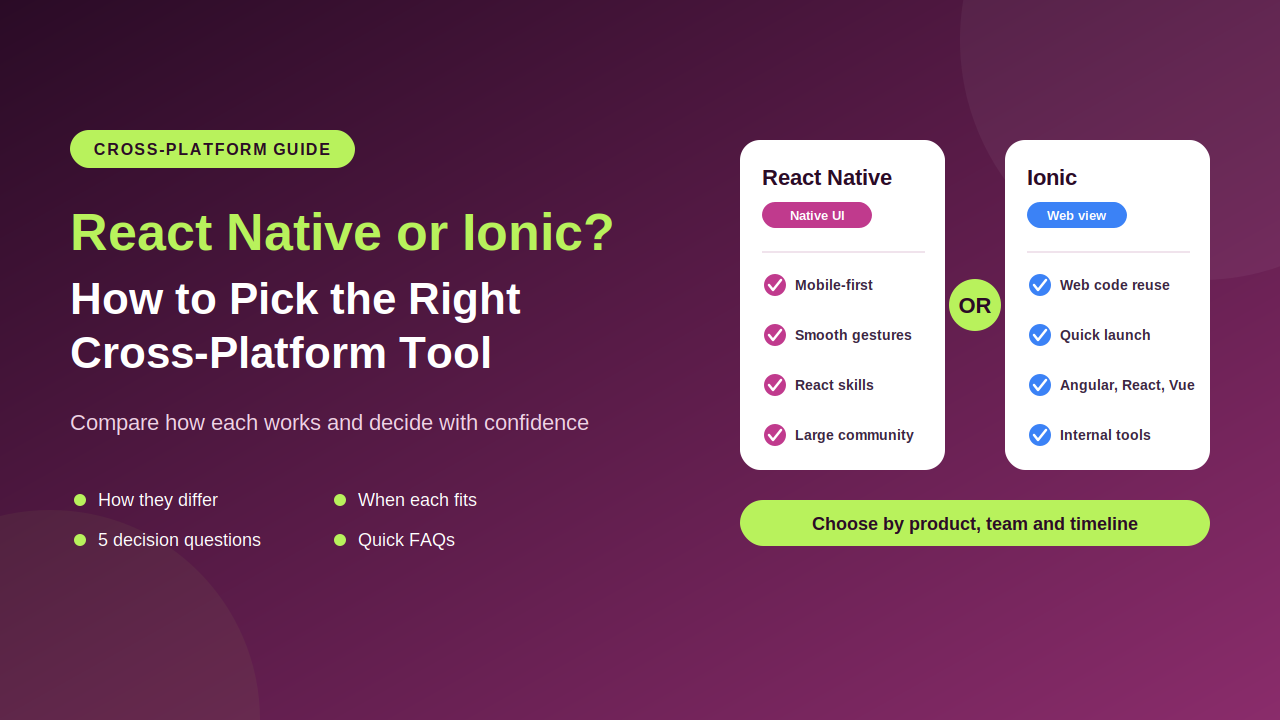
Apps built with React Native or Flutter alone are no longer a small corner of the mobile market. Appfigures found that they made up 15 percent of new App Store and Google Play releases in 2024, up from 7 percent in 2020. That growth means more businesses now face the same question: which tool should we build on? Two names come up often, especially for teams that already have web skills. This guide explains React Native vs. Iconic in plain language, so you can make the call with confidence.
Same Goal, Two Very Different Engines
Both tools belong to cross-platform mobile app framework, where one team builds for iOS and Android together instead of creating two separate apps. The difference lies in how each one gets there. React Native, which Facebook open-sourced in 2015, lets developers write JavaScript or TypeScript and displays real native interface components on the screen. Ionic works in another way, since it uses web technologies such as HTML, CSS, and JavaScript, and it is usually paired with Capacitor, which wraps the web app inside a native shell that runs in a web view.
Head-to-Head: What Really Differs
This table shows the practical differences that matter most when you plan a project:
| Factor | React Native | Ionic |
|---|---|---|
| Core technology | JavaScript or TypeScript with React | HTML, CSS, and JavaScript with Angular, React, or Vue |
| How the screen is drawn | Native UI components | A web view inside a native shell |
| Performance | Closer to native, especially for interactive screens | Good for content and form-based apps, but heavy animation can be harder |
| Reusing a web app | Limited, since the interface is rebuilt | High, since existing web code can be wrapped |
| Best for | Consumer-facing, mobile-first products | Internal tools and web-first teams |
When React Native Takes the Lead
React Native app solution makes the most sense in these situations:
- Your product is mobile-first, and a smooth, native-feeling experience is a priority.
- Your app includes gestures, animations, or frequent screen transitions.
- Your team already knows React, so the learning curve stays small.
- You plan to grow the app over several years and want a large community behind it.
When Ionic Is the Smarter Pick
Ionic app development shines when speed and web reuse matter more than a fully native feel:
- You already have a web application that you want to bring to the app stores.
- Your app focuses on forms, dashboards, or content, such as an internal business tool.
- Your team is strong in Angular, React, or Vue and has little mobile experience.
- You need a working version quickly with a limited budget.
One caution is worth noting. Appfigures observed in late 2024 that the share of apps using Ionic was falling, while React Native and Flutter kept growing. That does not make Ionic a poor choice, but it is wise to check community support and long-term plans before you commit.
Five Questions to Settle the Debate
- Is your product mobile-first or web-first? Mobile-first products usually lean toward React Native.
- How demanding is the user experience? Smooth animations and gestures favor native components.
- What skills does your team already have? Choose the tool that matches your existing strengths.
- How soon do you need to launch? Wrapping an existing web app can shorten the timeline.
- Where will the product be in three years? Pick the option that supports your growth plans.
Final Thoughts: Let Your Product Decide, Not the Hype
The React Native vs Ionic debate has no universal winner. React Native fits products that need a polished mobile experience, while Ionic works well for web-first teams that want to move quickly. Start with your users, your team, and your timeline, and the right answer usually becomes clear.
Frequently Asked Questions
1. Is React Native better than Ionic?
It depends on your goals. React Native usually feels more native, while Ionic is stronger when you want to reuse an existing web app.
2. Which one is faster?
React Native generally performs better for interactive, animation-heavy apps, because it uses native components instead of a web view.
3. Which one costs less to build with?
Ionic can cost less when you already have web code to reuse. For a new mobile-first product, the difference is smaller, so compare your specific needs.
4. Can an Ionic app feel as smooth as a native app?
For simple, content-driven apps, yes. For complex animations or heavy interactions, a native-based approach usually feels smoother.
5. Which is better for startups?
Startups building a consumer app often prefer React Native, while those extending an existing web product may find Ionic faster.

